Understanding Call Screening
AI-powered call screeners are now common on mobile devices, particularly with Apple’s iOS call screening features. When a rep places an outbound call, the recipient’s device may intercept it and prompt the caller to state their name and reason for calling — before the recipient ever picks up.
These screeners are designed to evaluate three things almost instantly: who is calling, who they represent, and why. A response that doesn’t address all three tends to get flagged as an unsolicited or unknown caller, causing the call to drop or go unanswered.
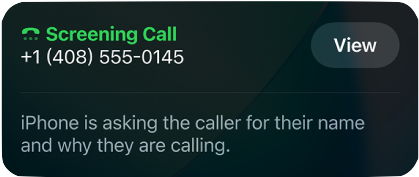
Call Screening introduced in iOS 26
The three-part response framework
Every screener response should cover the following three elements in a single, natural-sounding sentence.
| Element | What to include | Why it matters |
|---|---|---|
| Your full name | First and last name | Signals a real, accountable person |
| Your company | Full company name | Adds immediate organizational credibility |
| Your reason | A specific, human purpose | Explains why this call is relevant to the recipient |
Example 1: Housing placement outreach
Before: “Alex, Sunshine Properties on ListingHub” After: “Hi, this is Alex Rivera with Acme Housing Partners. I help coordinate temporary housing placements for professionals relocating for work, and I have a listing I think could be a great fit for someone I’m currently working with.”
Example 2: Staffing or services outreach
Before: “Jordan, Staffing in the Midwest” After: “Hi, this is Jordan Lee calling from Premier Staffing Solutions. I work with organizations across the Midwest to help fill temporary staffing needs, and I wanted to reach out about an opening I thought you might be able to assist with.”
The more transparent you are, the more likely it is that your call gets through screening and earns the consumer’s engagement. Call Screening rewards clarity and penalizes deceptive spam-like calling behavior.
Additional Tips
- Answer follow-up questions directly. Some screeners ask a second prompt — respond completely rather than trying to skip past it.
- Follow up if a call drops. A brief voicemail or text with the same context warms the contact before your next attempt.
- Prepare scripts in advance. Reps shouldn’t be improvising when a screener prompt catches them off guard. A few role-specific scripts go a long way.
Caller ID and Brand Recognition Is Essential
Both platforms are prioritizing verified identity and branded transparency.
With Revenue.io, your organization can:
- Display Caller ID (CNAM) information to landlines so customers know who is calling
- Enable Branded Calling integrations so your company name can appear before the call connects on mobile devices
When your brand identity is visible and verifiable, you stand apart from anonymous or deceptive callers. This improves both connection rates and consumer trust.
Respect the Consumer’s Right to Choose
Call Screening empowers users to control which calls they engage with.
The best sales organizations align with this shift instead of resisting it.
That means:
- Calling only customers who have given consent or expressed interest in being called
- Using Insights in Salesforce and Revenue.io to reach out at the right time, with the right messaging, and through the right channel
- Blending calls with personalized follow-ups by SMS, email, or LinkedIn to give the consumer options for communication
When consumers feel in control of the communication and that their attention is respected, they are far more likely to respond and convert.
The Bottom Line
Call Screening from Apple and Google signals a permanent shift toward transparent, consumer-first communication.
The outbound seller is not disappearing. It is evolving. With Revenue.io’s Caller ID, Branded Calling, and AI-powered engagement tools, your business can thrive by turning transparency and analytics into measurable call outcomes.