Slow Drip
Slow Drip manages the flow of daily participant actions so users are not overburdened when a large number of participants enter a sequence. It keeps workload manageable by limiting how many participants are activated per working day.
Enable Slow Drip
To use Slow Drip, go to Salesforce Setup > Custom Settings > GS_Public Settings to check the setting "<Sequence> Enable slow drip".
On the sequence, turn on “Do you want to control the no. of participants that enter per day?” and enter the number of daily participants a single rep should receive for this sequence per working day.
To configure working days, see Configure Working Days and Business Hours.
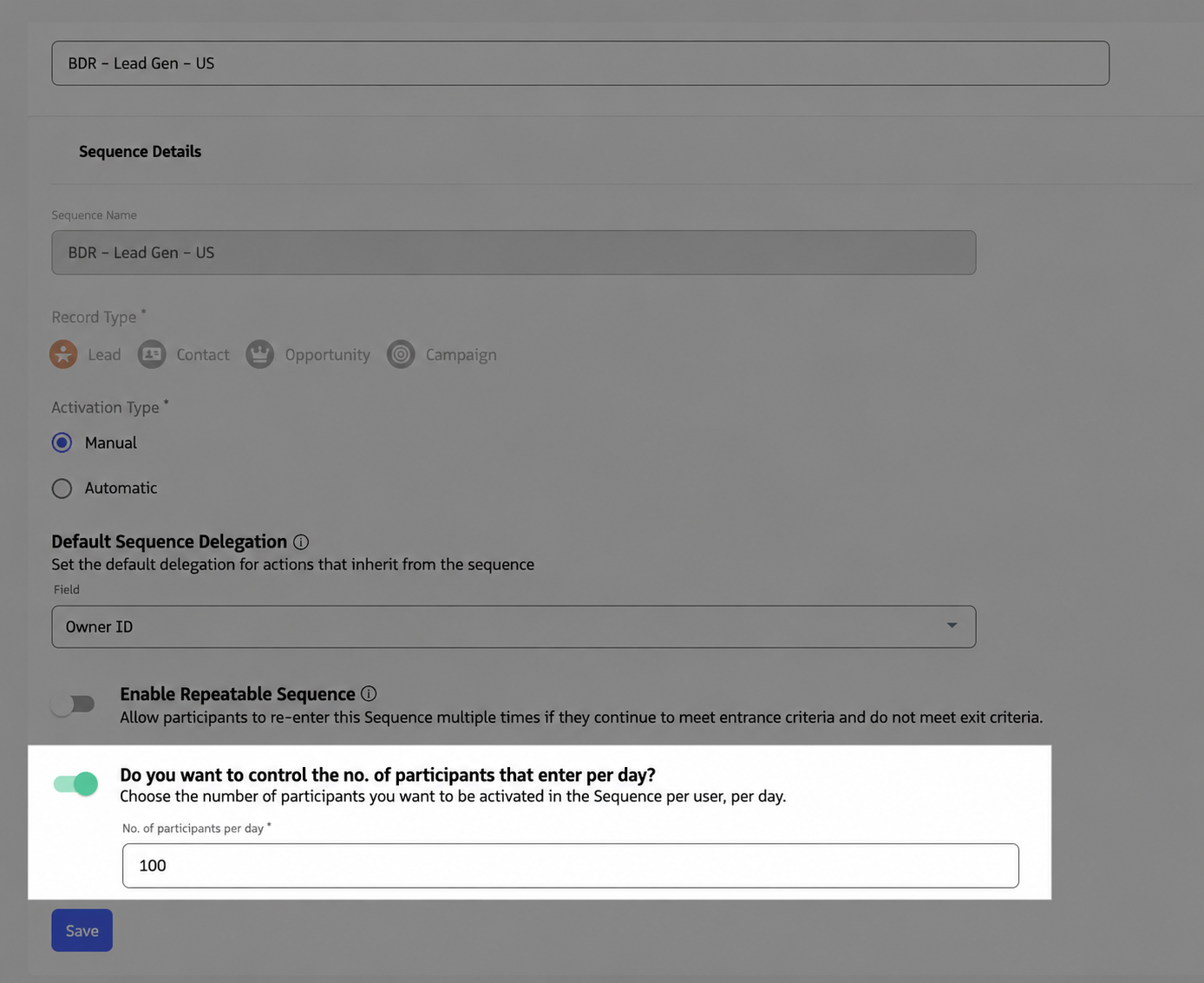
Configure Slow Drip on the sequence by turning on the setting and entering the daily participant limit.
How Slow Drip works
When participants are added to a sequence with Slow Drip configured, Guided Selling compares the number of participants that have been activated for the day against the drip limit, and creates a Sequence Association record with a status of Queued for any participants over the limit. No actions are created yet for a Queued participant.
A nightly scheduled job runs against the daily limit. If there is capacity, it removes participants from the virtual queue and activates them. At this time, their first action is created and scheduled according to the time they were activated.
Example
Suppose you have an active Lead sequence with 100 participants added on day 1, and one rep owns 60 participants and another rep owns 40. The drip limit is set to 10 for this example.
Day 1: 10 participants are activated for each rep; the other 80 will be queued.
Day 2: The nightly job updates the status, from Queued to Active, of the longest-waiting participants, according to the time of association (e.g. createddate on Sequence Association). Rep 1 has 20 Active participants now, with 40 still Queued. Rep 2 has 20 Active participants, with 20 still Queued. This continues each day until the queue is empty.
That way users see a limited set of new participants per sequence each day instead of being overwhelmed when many records qualify at once.
However, the number of actions due per day are not limited, and may continue to rise as new participants are activated. Actions for Active participants are scheduled according to normal sequence rules and timing, starting at the point they became Active. Active sequences are no longer affected by drip limits.